
Failure vs. Friction: The Test for New Tech That Never Changes
Jun 01, 2026
Every Generation of Business Owners Gets Seduced by the Shiny New Thing. Here's the Test That Never Changes.
Right now, the hottest version of this story is playing out in AI. But the underlying question has been the same for decades.
|
You know the feeling.
Someone shows you something new — a tool, a platform, a device, a system — and your first reaction is: that's impressive. Clean design. Obvious effort. A demo that makes you feel like you've been doing things the hard way.
And then, somewhere between the demo and your credit card, a quieter voice asks: but do I actually need this?
That moment — the gap between "impressive" and "necessary" — is one of the most important judgment calls you make as a business owner. Get it right consistently, and you build a lean, focused operation that invests where it matters. Get it wrong consistently, and you accumulate a graveyard of subscriptions, devices, and platforms that seemed essential in January and were forgotten by April.
This has always been true. But right now, in 2026, it's playing out at a scale and speed that's genuinely new.
The hottest category in business today is AI tools. And the market is moving so fast that the gap between "this looks impressive" and "this is actually necessary" is harder to see than ever — because everything is impressive, the demos are genuinely good, and the sales pitches have gotten very, very sharp.
So I want to walk through a specific example — a real product, a real decision, a real set of questions — and use it to surface a framework that works for any tool, AI or otherwise, that lands on your desk asking for your time and money.
The product is called PLAUD. It's become one of the most talked-about AI gadgets in the business world. And whether you end up buying it or never thinking about it again, the way you think through it will sharpen how you evaluate the next ten tools after it.
What PLAUD Is (And Why It's the Perfect Case Study)

Credit-card thin. Snaps magnetically to the back of your iPhone. You press one button before a meeting, forget about it, and walk out with a full transcript, an AI-generated summary, and a clean list of action items. No notes. No follow-up scramble. No "hey, can you send me a recap of that?"
It costs about $159 for the hardware, plus $99 a year for the full subscription. It's sold over 1.5 million units. The reviews are largely positive.
The companion app, powered by GPT-4, produces transcripts, meeting summaries, action items, and even mind maps. Accuracy runs around 90–95% for native English speakers in clean environments. Its standout technical feature — a Vibration Conduction Sensor — lets it record phone calls by reading physical vibrations from your phone's chassis, bypassing the permissions Apple doesn't grant to apps. That's genuinely clever engineering.
Reviewers who use it daily are enthusiastic. One professional reported that instead of scrambling to write down deliverables and deadlines during client calls, they could focus entirely on the conversation — the transcript handled everything, and the key details were waiting afterward.
That's real value. So what's the problem?
The problem is that "real value" and "necessary investment" are not the same thing. And understanding why they're different — in this case and in every case — is the whole point.
The Substitution Test: The First Question Every Owner Should Ask
Before I get into the AI-specific dynamics, here's the foundational question I apply to every tool, platform, or system I'm evaluating. It cuts through more noise than anything else I've found:
If this tool disappeared tomorrow, what would actually break in my business?
Not "what would be inconvenient." Not "what would I miss." What would break — meaning: a real workflow fails, a real outcome degrades, a real cost appears.
If the answer is "we'd struggle to operate" or "we'd lose meaningful performance," then you're looking at something essential. Buy it confidently.
If the answer is "we'd find another way" or "we'd stitch together a workaround in a day," then you're looking at something substitutable. Proceed with real skepticism.
Run that test on PLAUD for your business.
The device does three things: records, transcribes, and summarizes. Now ask yourself:
- Recording? Your smartphone already does this.
- Transcription? Zoom, Google Meet, Otter.ai, or your phone's native tools handle this. Already available, often already paid for.
- Summarization? Any modern AI assistant handles this in seconds from a pasted transcript.
PLAUD is not enabling a capability that didn't exist before. It's packaging three existing capabilities into a more convenient, more reliable form factor. And that distinction — between a new capability and a better package — matters more than most people realize when they're making a buying decision.
The Timeless Business Principle Hidden Inside Every "New" Tool Decision
Here's where I want to step back from AI entirely for a moment — because this next idea predates AI, smartphones, and probably most of the technology in your office.
The Business Principle: Convenience Creates Adoption. Necessity Creates Durability.
Every generation of business owners faces a version of the same decision: a new tool arrives that makes something easier. It reduces friction. It streamlines a step. It's faster or simpler than what came before.
And the question is always the same: is this making something easier that was already getting done, or is it making something possible that couldn't happen before?
The first category — easier — can absolutely be worth buying. But it's rarely worth betting on. Because "easier" is fragile. A platform update, a competitor feature, a shift in how your industry works — and suddenly what made the tool valuable is available everywhere for free.
The second category — possible — is where durable value lives. When a tool removes a genuine constraint, it earns a place in your operation that's hard to displace. Not because you like it. Because removing it would actually cost you something real.
The practical test: before you buy anything new, ask yourself honestly — is this tool solving a friction problem or a failure problem? Friction problems are real, but they're also substitutable. Failure problems — the ones where, without a solution, something actually breaks — are the ones worth investing in seriously.
This distinction — friction versus failure — is the lens through which I evaluate every tool that shows up on my radar. And it's the lens that makes the PLAUD decision much clearer.
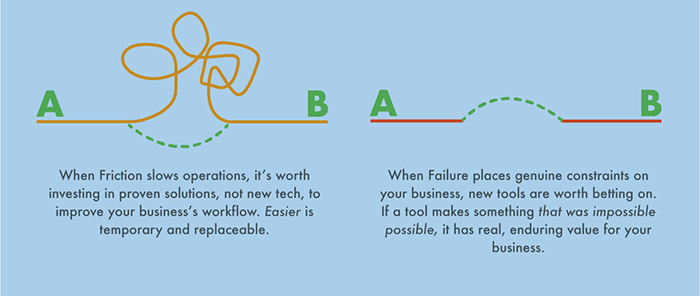
PLAUD, for most businesses, is solving a friction problem. The recording happens anyway. The notes get taken anyway. It may be less clean and require more effort, but the process doesn't fail without the device. It just costs a little more time and attention.
For that class of problem, the threshold for investment should be high — because you're not removing a constraint, you're smoothing a bump. And bumps, in a fast-moving market, tend to get smoothed by the next platform update anyway.
Why the AI Market Makes This Harder to See
Now back to the AI-specific dynamics — because there's something genuinely different about evaluating tools in this category right now, and it makes the friction-versus-failure distinction even more important to apply rigorously.
In most tool categories, the competitive landscape is relatively stable. A good CRM is still a good CRM next year. A good accounting platform doesn't suddenly become obsolete because a competitor added a feature.
AI is different. The underlying capabilities are improving at a pace that compresses the value of any given tool from two directions simultaneously.
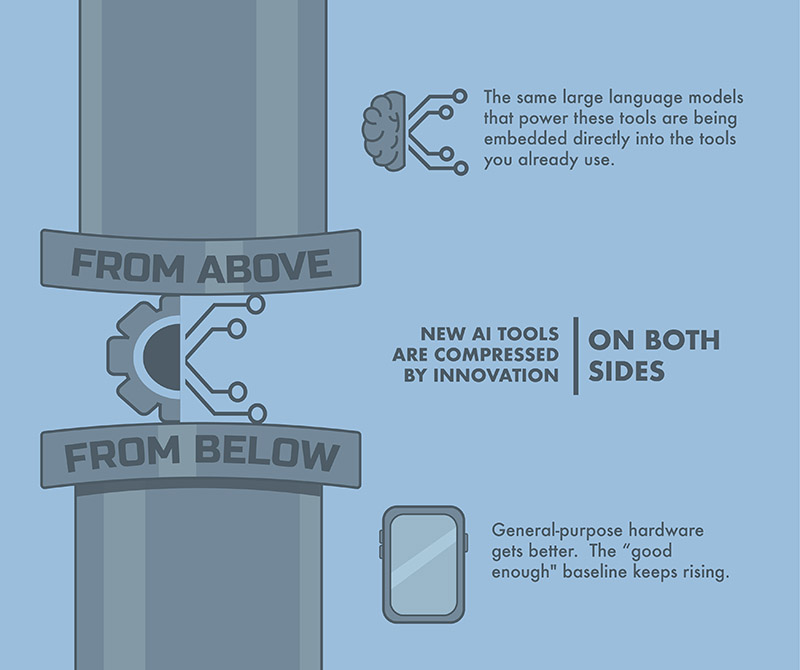
From below, general-purpose hardware gets better. Smartphone microphones are dramatically better than they were three years ago. Apple Intelligence and Google's AI features are adding native transcription and summarization directly into the operating system. The "good enough" baseline keeps rising.
From above, AI software platforms expand. The same large language models that power PLAUD's summaries — GPT-4, Claude, Gemini — are being embedded directly into the tools you already use. Your CRM, your email client, your video conferencing software. They're all adding AI-generated summaries and action items as standard features, often at no additional cost.
The result is predictable: anything sitting between improving hardware and expanding AI platforms gets squeezed from both sides.
PLAUD doesn't control their microphone technology — that's commoditized hardware. They don't control their intelligence layer — that's OpenAI and Anthropic. They're sitting above commoditized hardware and below commoditized intelligence. That's a structurally weak position, no matter how well the product works today.
And there's one more dynamic that makes this worse: iteration speed asymmetry.
Software improves continuously. AI models update. Apps evolve. Outputs get better week by week. Hardware does not. Once a device ships, the design decisions are locked in. The constraints persist in the field. Improvement cycles can stretch into months or years due to supply chain realities.
Think about what this means for a product whose core value depends on an AI layer it doesn't own — an AI layer that's improving faster than any hardware revision cycle can match. The gap between where the value is improving and where the product is fixed widens over time, not narrows.
This is why your skepticism about AI gadgets isn't technophobia. It's pattern recognition applied to how markets actually work.
But Here's Where It Gets Interesting
I've been making a structural argument for skepticism. Now let me complicate it — because the real insight isn't "PLAUD is a bad product." It's that most people are solving the wrong problem.
Think about how information actually moves through a deal or a client relationship in your business.
You have a prospect call on a Tuesday. Notes get taken — maybe even a recording. But by Friday's follow-up call, half the context is gone. The pricing discussion from meeting one doesn't connect cleanly to the timeline conversation from meeting two. The handoff from your salesperson to your delivery team loses three details the client mentioned offhand. The deal stalls — not because your product is wrong, but because the thread got dropped somewhere between conversations.
That's not a note-taking problem. It's a state management problem.
And the stakes are especially high if you sell something complex: B2B services, professional consulting, custom manufacturing, financial products, real estate — any situation involving multiple conversations, multiple stakeholders, evolving requirements, and cycles that span weeks or months.
In those environments, the failure mode is almost never "we didn't record the meeting." The failure mode is:
- Context is lost between interactions
- Critical details were not carried forward into the next conversation
- Next steps that are vague or contradictory
- Internal alignment that quietly breaks down
- Deals that stall because nobody's sure what's blocking them
That's a consequential, frequent, expensive problem. And that is the only context in which a tool like PLAUD — or any AI-powered conversation intelligence tool — clears the friction-versus-failure threshold and becomes worth serious investment.
Not because it records better. Because it could, in the right configuration, maintain a living, evolving, structured record of a complex process — and that's something your existing tools genuinely cannot do well.
The Real Use Case: Where the Math Actually Changes
Here's the specific scenario where the calculation flips.
Imagine you're selling a complex solution — managed services, financial advisory, custom construction, enterprise software — to organizations with multiple decision-makers and a sales cycle that spans weeks or months.
Every deal involves 8, 10, maybe 12 conversations. Each one surfaces new information: stakeholder concerns, budget constraints, competing priorities, internal politics you didn't know existed. Each one generates commitments — from you and from them — that need to be tracked.
Your current workflow probably looks something like this: Zoom call → scrambled notes → some of it makes it into your CRM → most of it lives in someone's head → next meeting starts slightly cold because you're rebuilding context → repeat.
The cost of that friction is real. Deals take longer. Misalignments surface late. Handoffs to delivery teams are incomplete. Client confidence wobbles when they feel like they're repeating themselves.
Now imagine instead: every conversation is captured, structured, and automatically fed into your CRM as a clean update. The AI tracks what was said, what was agreed, what's still unresolved. Before your next call, you get a briefing — here's where we left off, here's what they said they needed to decide, here's what you committed to. Your team is aligned. You walk in prepared. The client feels heard.
That's not a recording device. That's deal intelligence infrastructure. And that is a failure problem — one worth investing in seriously because the cost of not solving it shows up in your close rate, your cycle length, and your delivery quality.
The catch? PLAUD, as currently positioned, isn't fully there yet. It's excellent at the capture layer. The deeper intelligence — structured extraction across multiple conversations, CRM integration that's actually clean, deal-state awareness over time — is still developing. Stitching together a workflow from Notion, GPT, Otter.ai, and Salesforce is painful enough that a purpose-built solution, if it executes well, could absolutely displace it. But that purpose-built solution doesn't quite exist yet.
Watch the space. The businesses that build the workflow discipline now will have a structural advantage when the tools catch up.
A Framework for Every AI Tool You're Being Pitched
Whether it's PLAUD or the next AI tool that lands in your inbox, here are four questions that cut through the noise faster than any demo:
- What specific constraint does this remove — not make easier, but actually remove?
There's a meaningful difference between a tool that makes something more convenient and a tool that makes something possible that wasn't before. "It saves time" isn't a constraint. "We lose deal context between meetings, and it costs us follow-up accuracy" is a constraint. The more specific you can be, the more honest your evaluation becomes.
- How often does that constraint actually occur in my business?
Daily friction that compounds is worth solving aggressively. Occasional inconvenience is worth tolerating. Most tools get evaluated against imagined use cases rather than actual ones. Be honest about frequency before you commit real money.
- What does it actually cost when it's not solved?
This is the question most people skip. If the constraint goes unresolved, what's the real dollar impact? Lost deals? Rework cycles? Staff time? Client attrition? If you can't roughly quantify it, the problem probably isn't as consequential as the demo made it seem.
- How easily can this be replaced as the market evolves?
Given how fast AI capabilities are moving, will this still be meaningfully differentiated in 18 months? If the answer is probably not, that's not a reason to never try it — but it is a reason to stay on a monthly commitment rather than an annual one, and to treat it as an experiment with honest exit criteria rather than a long-term investment.
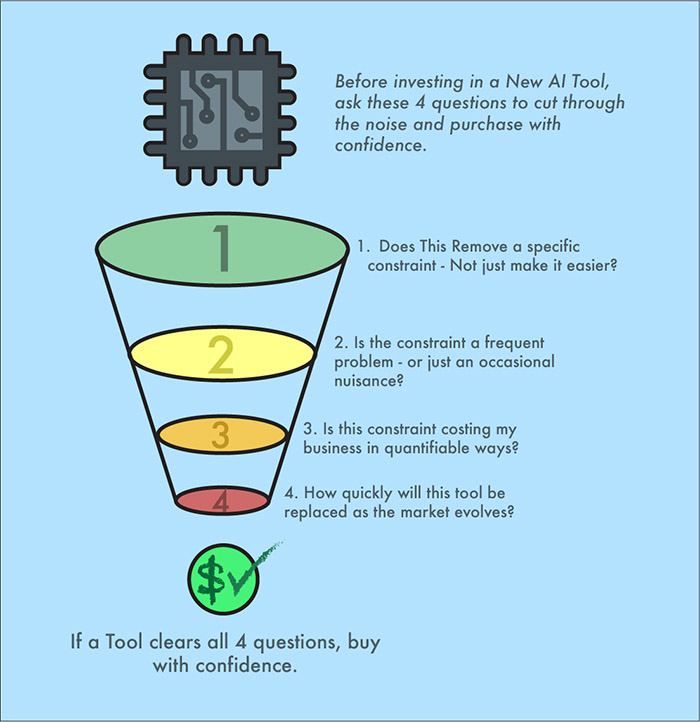
Tools that clear all four questions are rare. They tend to be genuinely transformative when you find them. Tools that fail on one or more aren't necessarily bad — they're just not investments. They're experiments, and they should be treated accordingly: low commitment, clear trial criteria, honest exit ramps.
The Honest Verdict on PLAUD
Practically, by business type:
If you occasionally record meetings and a phone or existing app handles that adequately — PLAUD is not worth $258 in year one. It's a well-designed product that solves a problem you already have an acceptable answer for.
If you're an on-the-go professional — a real estate agent, a consultant, a financial advisor — who takes a lot of in-person meetings and is genuinely losing information because your current system fails you repeatedly, the one-button reliability and phone-independence have real value. The hardware is probably worth trying; evaluate the subscription honestly after 90 days of actual use.
If you run a complex, multi-stakeholder sales or service process — enterprise sales, professional services, bespoke anything with long cycles and multiple decision-makers — this category of tools is building toward something that will matter significantly for your revenue operations. Keep a close eye on where capture, CRM integration, and deal intelligence converge. That's where the real value will emerge, and it's closer than most people think.
A Final Thought
I started with the moment every business owner knows — that gap between "impressive" and "necessary."
The reason that moment matters more today than it did five years ago isn't that tools are better or worse. It's that the speed of change has collapsed the window between "this is differentiated" and "this is table stakes." What earns a premium today gets bundled into your existing platform tomorrow. What requires a dedicated tool this year gets absorbed into the OS next year.
In that environment, the businesses that win aren't the ones that adopt the most tools. They're the ones who adopt the right ones — the ones solving for failure, not just friction — and hold the line on everything else.
That's always been true. The AI era just makes it more urgent to get it right.
The standard for what earns a place in your business is getting higher. That's not a reason to be paralyzed. It's a reason to ask better questions before you buy.
What AI tools are you evaluating in your own business right now — and what's your process for deciding? I'd genuinely like to hear what's working, what you've bought and regretted, and what you're watching. The conversation is often as valuable as the conclusion.

